Design AI agent architectures that hold up. Even under attack.
Sketch an agent system on a canvas and simulate it: what it costs, where it breaks, and how an attacker gets in. No code, nothing deployed.
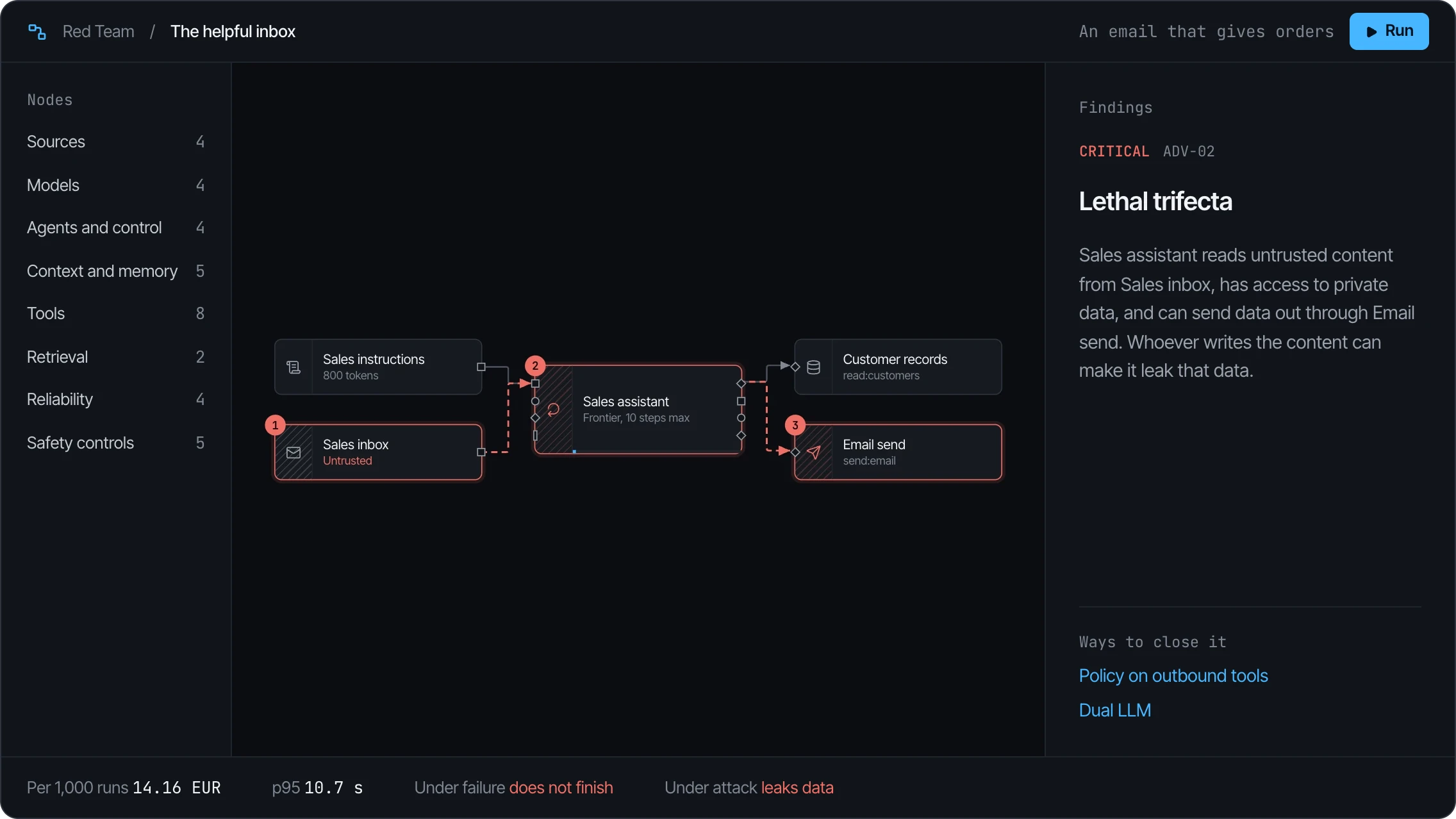
A demo shows the happy path. AgentSim shows the other four.
Every agent architecture you draw runs against four simulation engines: trace, cost and latency, chaos, and adversarial. You see what a production incident would show you, without the incident.
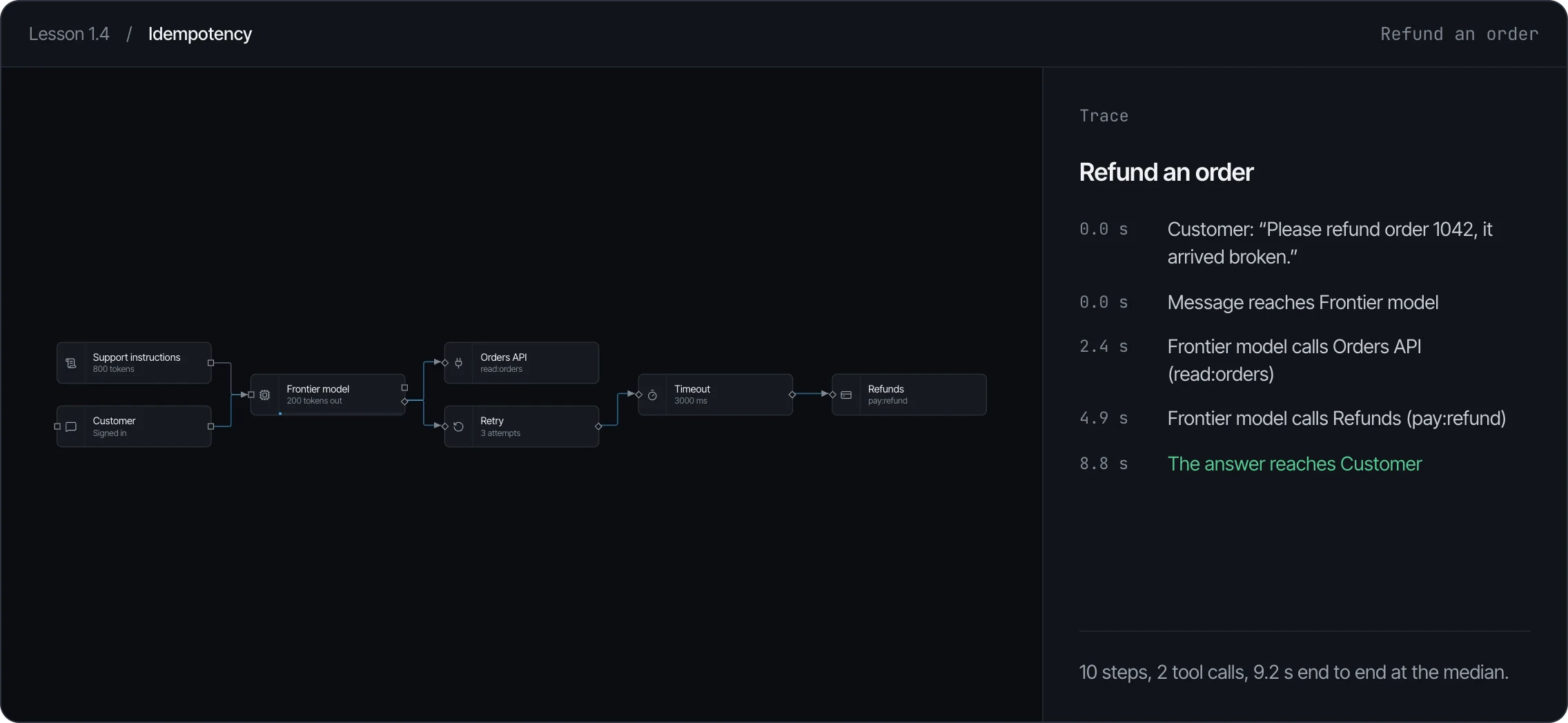
Graded by rules, not opinions. The same design always gets the same result, and every finding names the rule behind it.
Find the attack path before someone else does.
Agents read content written by strangers: emails, web pages, uploaded files, customer messages. That is how prompt injection gets in. The adversarial engine traces where that content can travel and flags every route to a tool that leaks data, spends money or changes something for good.
- ADV-01Attack pathA model that reads untrusted content can be steered by its author, and so can every tool it calls.
- ADV-02Lethal trifectaPrivate data, untrusted content and a way to send data out, all in one model, is how data gets stolen.
- ADV-03Poisoned memoryAnything written to memory comes back in later sessions, including an attacker’s instructions.
- ADV-04Retrieval ignores permissionsA model can’t keep secrets. Anything retrieved into its context can end up in the answer.
- ADV-05Guardrail as the only defenceGuard models catch many attacks, but not all. They lower risk; they don’t remove it.
- ADV-06Approval shows a summaryIf the approver sees the model’s description, a hijacked model describes something harmless.
 RiskVoid
Already running an AI agent? Secure it with RiskVoid.
AgentSim is where you design an agent and test the design. RiskVoid checks an agent you have already built: it analyzes the source code, points to the vulnerable paths, and shows the code behind each finding and how to fix it.
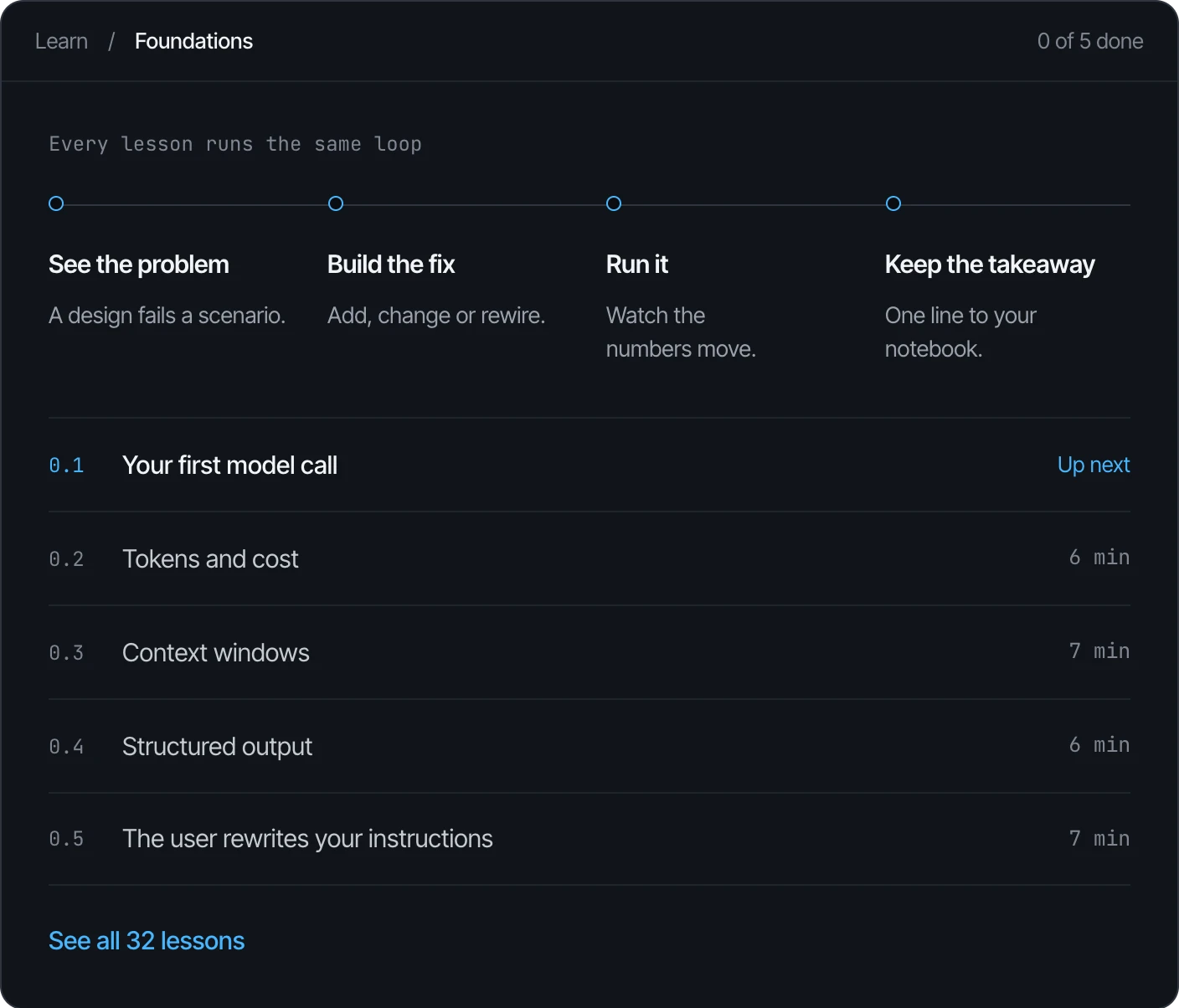
Five ways to get good at agent design
Start with ten-minute lessons, test yourself on open briefs, attack other people's designs, and keep a library of patterns you've actually seen fail.
See how a candidate thinks about agent architecture, with evidence you can explain, in one round.
Coding tests show whether someone can write code with AI. An AI system design interview on AgentSim shows whether they can design an agent system that works, scales, fails gracefully and resists attack.
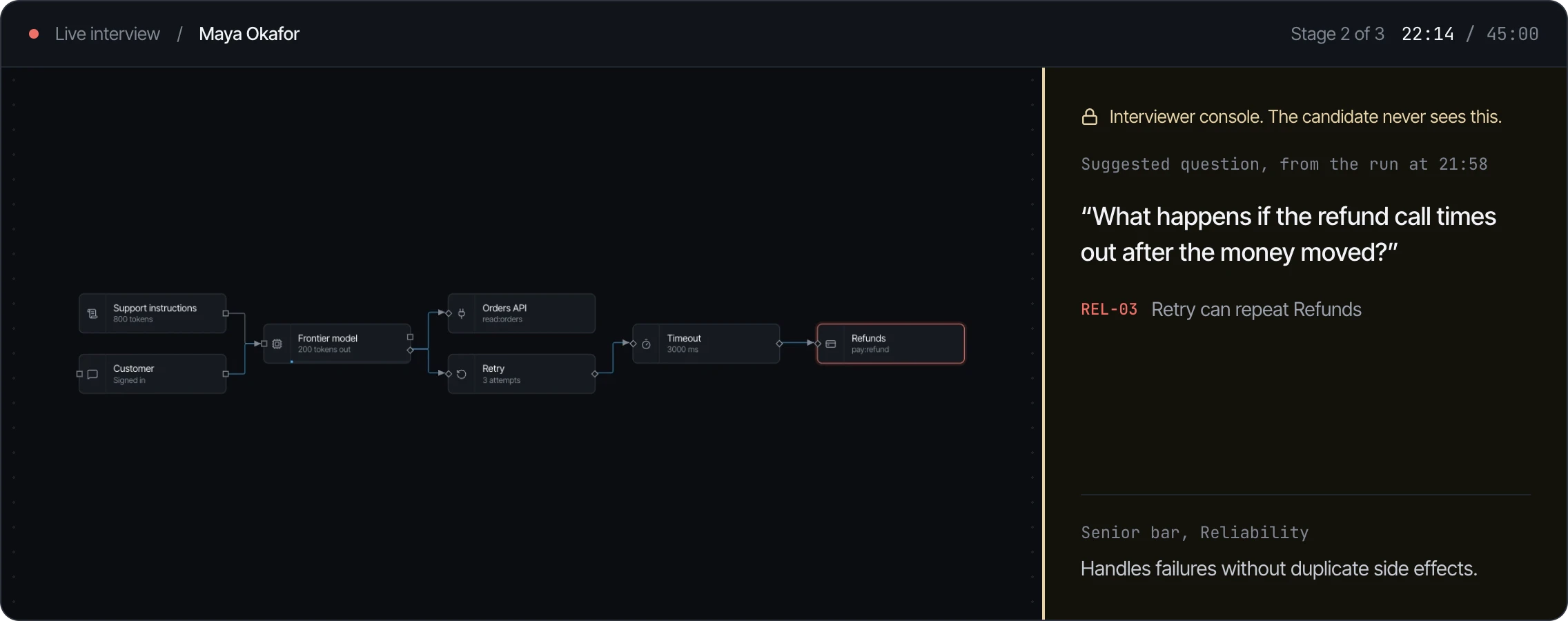
- Step 1Pick a templateEight staged problems, from a support agent with refunds to a multi-tenant agent platform, for mid, senior and staff roles.
- Step 2Run a live pair-design roundCandidate and interviewer share one canvas, next to your usual video call. You unlock new requirements as the design grows.
- Step 3Decide from evidenceA scorecard with engine evidence pre-filled, a replay of the build, and a report the committee can read in five minutes.
Why a design round
What your team gets
Learning is free. Hiring teams pay per seat.
- All lessons, challenges, puzzles and patterns
- The Studio, with share links
- No sign-up, nothing to install
- Your first 20 live interviews
- All 8 templates
- A short weekly feedback call
- 2 interviewer seats
- 15 live interviews a month
- All 8 templates
- 6 interviewer seats
- 50 live interviews a month
- Saved templates, candidate comparison
Good to know
Do I need to write code?
No. You design with nodes and connections: sources, models, agents, tools and controls. The engines run your design for you. It’s about architecture decisions, not syntax.
Are the costs and latencies real?
They come from a dated calibration table chosen to be in the right range for late 2026. They’re teaching estimates, not quotes from any provider, and the rules behind them are public.
Who is it for?
Engineers building with LLMs who want to design agents that hold up in production, and the teams who hire them.
Does AgentSim decide who gets hired?
Never. The engines produce evidence and interviewers write the recommendation. Nothing ranks, filters or rejects candidates automatically.
Where is candidate data stored?
In the EU. Your company is the controller, we’re the processor, and retention is set by you, 12 months by default.
Will candidates have seen the interview problems before?
Hiring templates come from a private bank that never appears in the free product, and each one has variants that get rotated.